A Monday Morning Standup
Let me take you back to a Monday morning standup.
Five engineers. One QA. A release scheduled to go out in two hours.
The product manager asks a simple question:
“Is it good to go?”
All you have are a handful of manual test cases you ran through at 11 PM the night before, hoping nothing broke in the build that went in at midnight.
If you’ve worked at a startup, this situation probably feels very familiar.
Now imagine the same Monday morning, the same team, and the same release - but with a different setup.
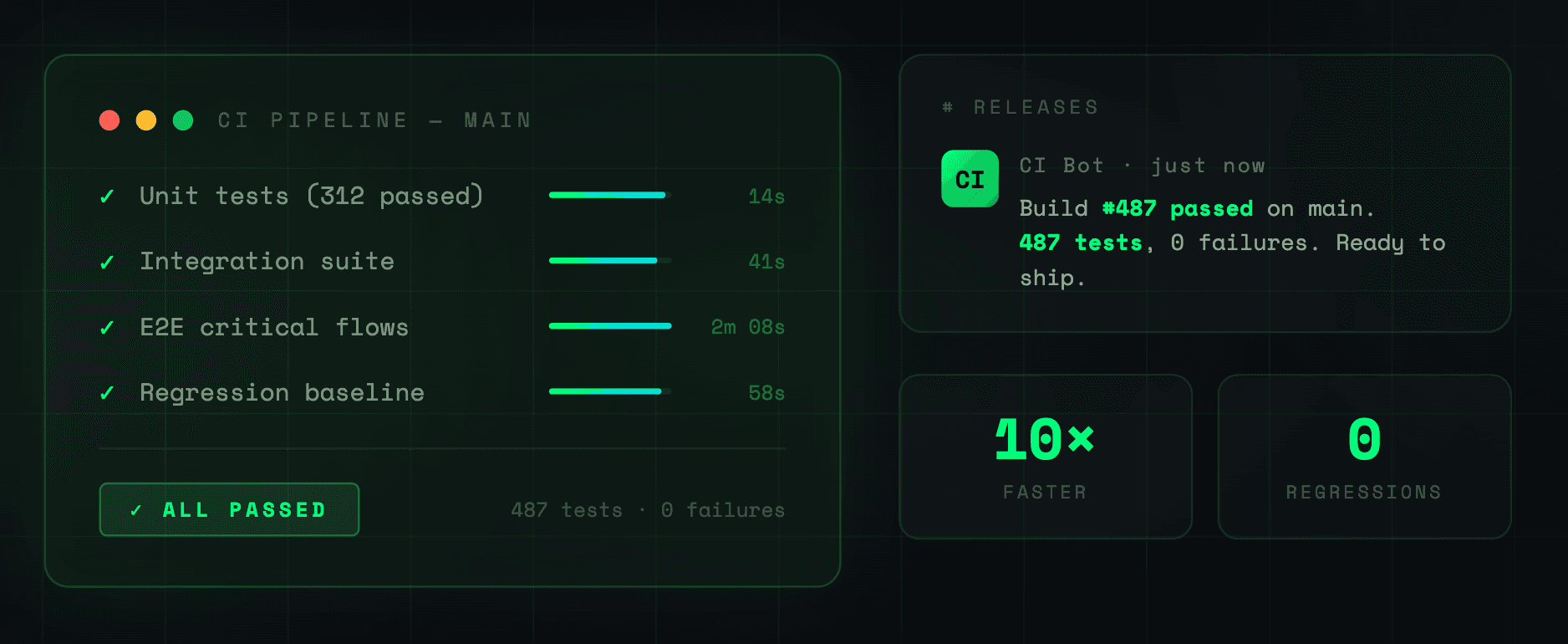
Instead of scrambling through last-minute manual checks, hundreds of automated tests ran overnight. Your CI pipeline shows a green checkmark. The test report has already been posted in Slack.
The product manager asks the same question.
This time the answer is simple:
“Yes. It’s good to go.”
That shift - from uncertainty to confidence - is what automation brings to a startup.
The Startup Reality: You Are Always Outnumbered
In large organisations, quality is supported by layers of people and processes.
A product may have:
- multiple QA engineers
- dedicated release managers
- staging validation teams
- structured UAT cycles
Startups rarely have any of that.
A typical startup team might have one QA engineer - sometimes none - responsible for the quality of the entire product.
Yet user expectations are exactly the same.
Startups don’t ship quarterly.
They ship weekly.
Sometimes daily.
The Limits of Manual Testing
Manual testing struggles to keep up with that speed.
A QA engineer might realistically execute 30-40 meaningful manual test cases in a day. Even that assumes perfect focus and no interruptions.
A well-designed automation suite can run hundreds or thousands of tests in minutes.
The difference isn’t just efficiency.
It’s scalability.
Without automation, QA engineers spend most of their time repeating regression tests instead of validating new features. The team becomes reactive, constantly checking that existing functionality hasn’t broken.
Automation gives that time back.
And in a startup, time is the most constrained resource.
Large Teams Have Buffers. Startups Don’t.
In larger organisations, several layers exist between a bug and the end user.
Issues might be caught during:
- staging validation
- QA sign-off cycles
- release approvals
- internal testing programs
These layers create a buffer.
Startups rarely have that luxury.
When a bug ships in a startup, a real user often encounters it immediately. That user might:
- complain publicly
- cancel their subscription
- or simply stop using the product
Automation acts as the safety net in this environment.
Every commit triggers automated tests that validate critical user flows. Regressions are caught early - often before anyone even notices the change.
Instead of relying on human memory or manual repetition, the system continuously verifies itself.
Speed Is a Startup’s Superpower
Startups compete with large companies primarily through speed.
Small teams can build, release, and iterate far faster than organizations burdened by layers of approvals and coordination.
But speed without safeguards quickly becomes fragile.
At first, technical debt feels manageable. Features continue to ship. Bugs are patched quickly. The team adapts.
Over time, however, instability accumulates.
Developers begin to hesitate before releasing changes. Regression risks increase. Fixing bugs becomes slower than building features.
Automation helps maintain the balance between speed and stability.
Developers can ship code confidently because automated tests verify that existing functionality still works. Meanwhile, QA engineers can focus on exploratory testing - uncovering edge cases, usability issues, and unexpected behaviours.
Automation doesn’t slow startups down.
It allows them to move fast without breaking everything.
Automation Is a Culture, Not Just a Tool
Many startups initially treat automation as a tooling decision.
Teams debate whether to use:
- Playwright
- Cypress
- Selenium
- Appium
These tools matter, but they rarely determine whether automation succeeds.
The real factor is culture.
Automation works best when quality becomes a shared responsibility across the engineering team.
Developers write testable code.
Product managers allocate time for testing during sprint planning.
CI pipelines prevent merges when tests fail.
In strong teams, automation becomes part of the development workflow itself.
Tests run automatically. Results are visible to the entire team. Quality is no longer the responsibility of a single person.
It becomes part of how the product is built.
The Future of Testing Is Becoming Smarter
The testing ecosystem is evolving quickly.
New tools powered by machine learning are beginning to assist with:
- generating test cases
- maintaining brittle test scripts
- selecting relevant tests based on code changes
Self-healing test frameworks are becoming more common. Some tools now allow tests to be written in natural language.
These innovations will make automation easier to maintain and more accessible for smaller teams.
However, the startups that benefit most from these advances are the ones that start building automation early.
Teams that delay automation often face a difficult problem later: retrofitting test coverage into a large and complex system.
That transition is significantly harder than starting small.
Conclusion
Automation is no longer a luxury in modern software development.
For startups, it is often the difference between building new features and constantly reacting to production issues.
Automated testing allows small teams to maintain high quality while shipping quickly. It provides the confidence needed to experiment, iterate, and improve the product without constantly worrying about regressions.
The best time to start building automation isn’t when the team grows larger. It’s now. Start small. Start today.
Even one automated test is better than none.