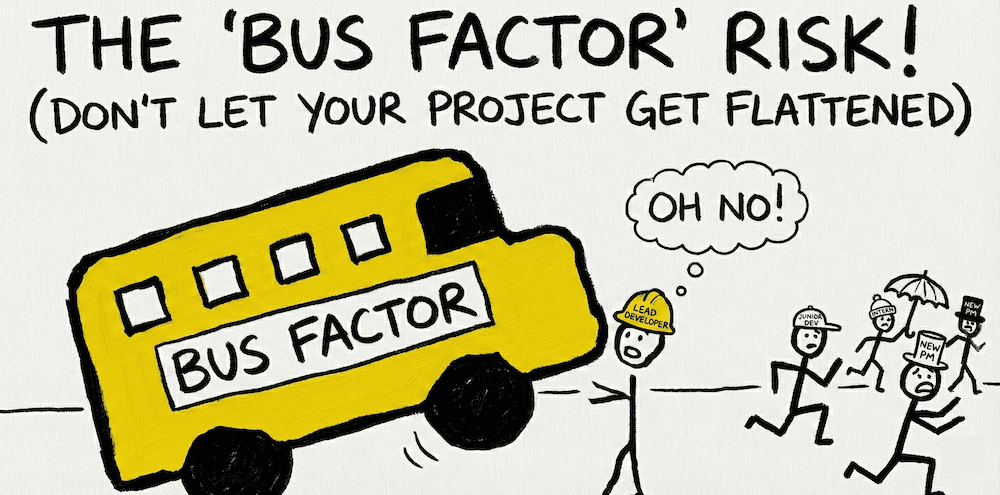
An often talked about hypothesis is the "Bus Factor" - a risk metric that asks: If your lead developer leaves tomorrow, does the project die?
If the answer is "yes," it is usually because the knowledge lives in that developer's head, not in the repository.
Here is how we can solve this using AI agents in our CI/CD pipelines to create "Living Documentation".
The Premise: The Problem in Hand
We are in the era of "Vibe-coding." Developers build faster than ever. Speed is high, but administrative tasks are ignored.
When a developer rushes a feature, they create Documentation Debt.
- The code changes, but the README.md stays the same.
- The API accepts new parameters, but the API spec is outdated.
- Ticket statuses in the project management tool are not updated.
Result: When a new developer joins, or the original author leaves, the project becomes a "Black Box." Nobody knows how it works, and everyone is afraid to touch it.
The Proposed Solution
We stop asking humans to write summaries. Humans are bad at maintenance. We let the code write its own history.
We integrate an AI Agent (using LLMs) directly into the CI/CD pipeline.
The Workflow:
- Trigger: Developer pushes a commit or merges a Pull Request.
- Context: The pipeline feeds the `git diff` (the changes) and the current documentation to the AI.
- Action: The AI analyzes the logic changes and performs three tasks:
- Writes/Updates the documentation, raises a PR for developers to review the contents.
- Generates missing unit tests.
- Summarises the work for the project board.
Comparison: Traditional vs. AI-Driven
Let’s look at a concrete example: A Simple Weather App.
The Task: Integrate the `Windy.com` API to show a "Cyclone Risk" warning if a storm is near the user's location.
Case A: Un-documented Changes
Traditional: The developer adds a new field `cyclone_severity` to the API response JSON. They forget to update the API documentation. The Frontend team continues using the old schema, and the new feature never shows up in the UI.
AI-Driven: The AI detects the new field in the controller logic. It automatically opens a PR to update the `swagger.yaml` (or API docs) to define `cyclone_severity` as a required integer.
The docs remain true to the code.
Case B: Un-changed Tests
Traditional: The developer writes the logic to fetch data from Windy.com. The existing tests only check for Temperature and Humidity. The build passes, but the new Cyclone logic is completely untested.
AI-Driven: The AI sees a new function `getCycloneData()`. It checks the test folder and sees zero coverage for this function. It generates a new test file `test_cyclone_integration.ts` to mock the API response and ensure the data parses correctly.
The actual test coverage remains intact.
Case C: Missed Edge Cases (The "Windy" Scenario)
Traditional: The developer focuses on the success case (getting the data). The edge case where the external API itself goes down might not be handled. If Windy.com is offline, the app crashes instead of handling the scenario gracefully.
AI-Driven: The AI reviews the code. It notices the edge case and generates the following comment:
"You are calling the Windy.com API. If this service returns a 503 (Service Unavailable), the app will throw an unhandled exception. I suggest wrapping this in a try/catch block or returning a null risk value."
The live documents protect from missing scenarios.
Case D: Potential Bugs with Legacy Code
Traditional: The new feature requires the User Location object to be in specific coordinates. However, the legacy part of the app stores location as "City Name." The developer misses this conflict.
AI-Driven: The AI scans the repository. It flags a warning:
"The `getCycloneData` function expects Latitude/Longitude, but the `UserProfile` object primarily stores City Strings. This will fail for users who haven't enabled GPS permissions."
The app stays protected from unexpected crashes.
4. High-Level Overview: What We Achieve
By handing these tasks to AI, we change the nature of software maintenance.
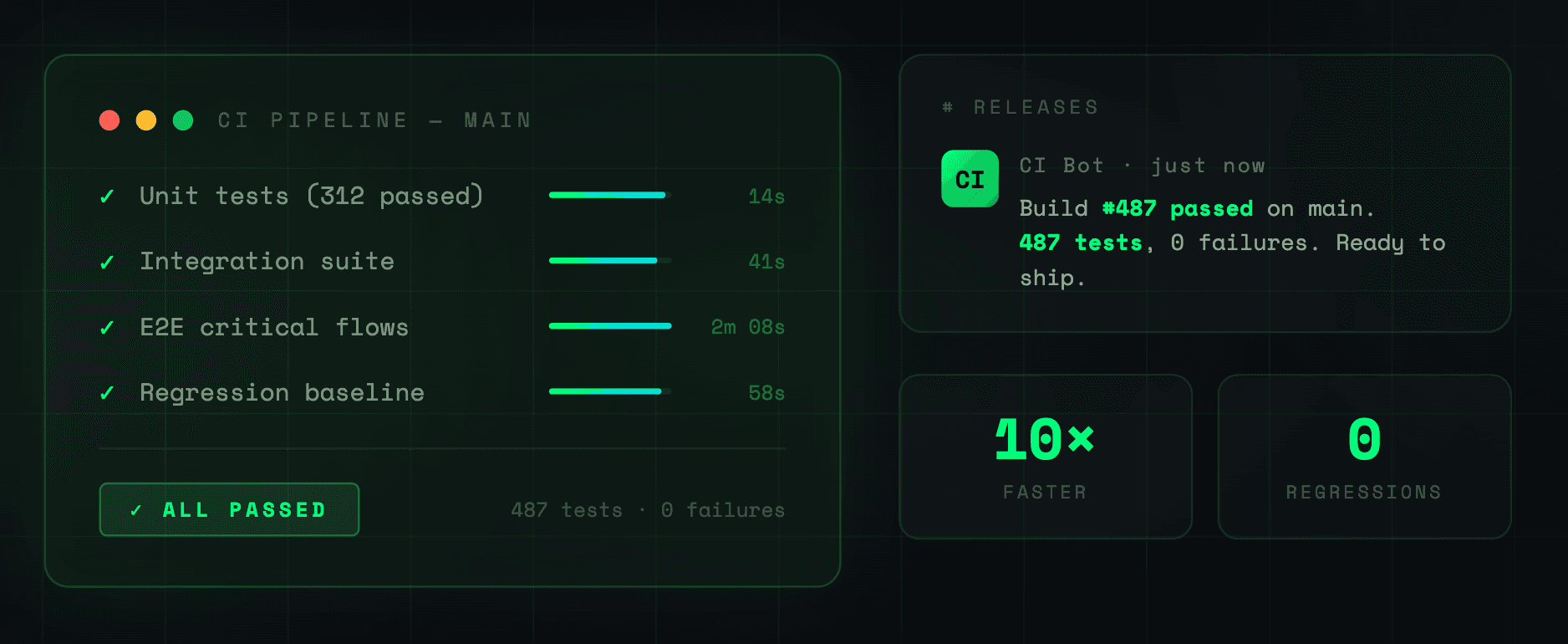
- Zero Knowledge Silos: The documentation is generated from the code, meaning the "truth" is always available to the whole team.
- Self-Healing Codebases: Tests expand automatically as the feature set expands. You don't end up with a massive app supported by trivial tests.
- Pure Engineering Focus: Developers spend 100% of their time solving problems (like integrating complex weather data) and 0% of their time writing status updates.
The goal isn't just to work faster. The goal is to make the project resilient, so it survives even if the core engineer is on leave or has left.
The entire flow would look something like this:

Takeaway
The goal of AI in the CI/CD pipeline isn't to replace the engineer; it’s to liberate them. By automating the 'administrative tax' of software development, we allow our best minds to stay in the flow state, solving complex problems while the system quietly ensures that no knowledge is ever lost.
That’s not just automation it’s project insurance.